
Often, what matters is not simply what people know, but what they know others know. When something is common knowledge, everyone knows it, everyone knows that everyone knows it, everyone knows that, and so on.
A classic illustration is in The Emperor’s New Clothes: everyone can see that the emperor is naked, but no one wants to be the first to say so, fearing that others will regard them as foolish. Because they aren’t sure that others can see the same thing, everyone continues pretending that the emperor is clothed. Only when a child finally speaks up and the crowd begins repeating the observation does it become common knowledge, allowing everyone to openly challenge the pretense.
As Steven Pinker shows in his latest book, similar dynamics operate in everything from jokes and paper money to sexual innuendo and political revolutions. Many people, for instance, might wish to overthrow a dictator, but if they don’t know that others feel the same way, they might never band together to do it. A public statement or protest can help create common knowledge of their shared opposition, making it easier for them to coordinate.
Animal Welfare
We often think that progress in improving the lives of animals requires overcoming entrenched habits and attitudes. That’s surely part of the problem, but lack of common knowledge about our concern for animals might be another key barrier. A 2026 study, based on a nationally representative survey of more than 2,000 American adults, examined attitudes toward reducing animal suffering. Nearly 40% ranked reducing animal suffering toward the top of their policy priorities, and for most categories of animals, between 65% and 72% considered government programs to reduce human-caused animal suffering very or extremely important.
The researchers also asked participants to estimate other Americans’ views, and the results point to a striking case of pluralistic ignorance. Respondents rated reducing animal suffering at 5.5 out of 10 on average, but estimated that the average American would rate it at only 4.3. The gaps were even larger for specific policies: 86% supported a federal wildlife-cruelty law but estimated that only 62% of Americans would; 88% supported minimum-space requirements for pigs but estimated that only 65% would; and 67% supported banning octopus farming while estimating that only 41% would.
These findings suggest that concern for animal welfare may be more widespread than Americans realize. Making that concern common knowledge, then, might help us coordinate to protect animals.

Common Intuitions and SFE
Might something similar apply to suffering focused ethics (SFE)? SFE treats reducing (severe) suffering as a foremost moral priority. SFE is not exactly a household name in ethics, but the intuitions underlying it might be more widely shared than we realize.
Suffering-focused views have been defended throughout history, finding support in various philosophical and religious traditions. The moral importance of suffering is also a central theme in literature, and questions about whether positive goods can justify suffering are explored in theodicies and influential works such as Dostoevsky’s The Brothers Karamazov, Camus’s The Plague, and Ursula K. Le Guin’s The Ones Who Walk Away from Omelas.
The degree to which people have suffering-focused moral views, however, is unclear. There’s little empirical research on this question, and it often lacks rigor and representativeness. Nevertheless, some evidence suggests that people are sympathetic to the intuitions underlying SFE and regard reducing suffering as a moral priority, even if they do not believe it should always take precedence over other aims.
In a 2017 survey conducted by the Future of Life Institute, nearly 15,000 respondents were asked what a future civilization should strive for. Roughly one-third selected minimizing suffering as their highest priority, making it the most popular response, ahead of maximizing positive experiences.
A 2022 study asked people more directly to weigh happiness against suffering. When evaluating the moral value of populations and individual lives, participants tended to give suffering greater weight than happiness, even when the two were described as equally intense. In one experiment, participants judged that, on average, roughly 62% of a population would need to be happy for its existence to be better than nonexistence (if they weighted happiness and suffering equally, they’d presumably require just over 50% to be happy).
The authors’ pilot study produced an even stronger asymmetry. When participants compared possible worlds with different numbers of happy and suffering people, their responses implied that, on average, roughly 90–120 happy people were needed to offset each suffering person. A separate “button-press” version produced a similar ratio of about 100:1, compared with roughly 3:1 in the main studies.
The difference shows how sensitive these judgments are to framing. The pilot used a different way of presenting the tradeoff and did not explicitly equalize the intensity of happiness and suffering. In the button-press version, responses may also have reflected reluctance to personally cause suffering. The precise tradeoff people endorse is therefore uncertain, but these results provide further evidence that people place greater weight on suffering than happiness.
Finally, a small 2015 survey by Brian Tomasik offers suggestive evidence of how strongly people may prioritize avoiding intense suffering in their own lives. Roughly 100 Mechanical Turk respondents were asked how many additional years of happy life they would require in exchange for being burned in flames for one minute. 45% said they would refuse regardless of how many years they were offered, and another 33% required between 15 and an astronomically large number of additional happy years. Only 6% would accept the deal for fewer than five.
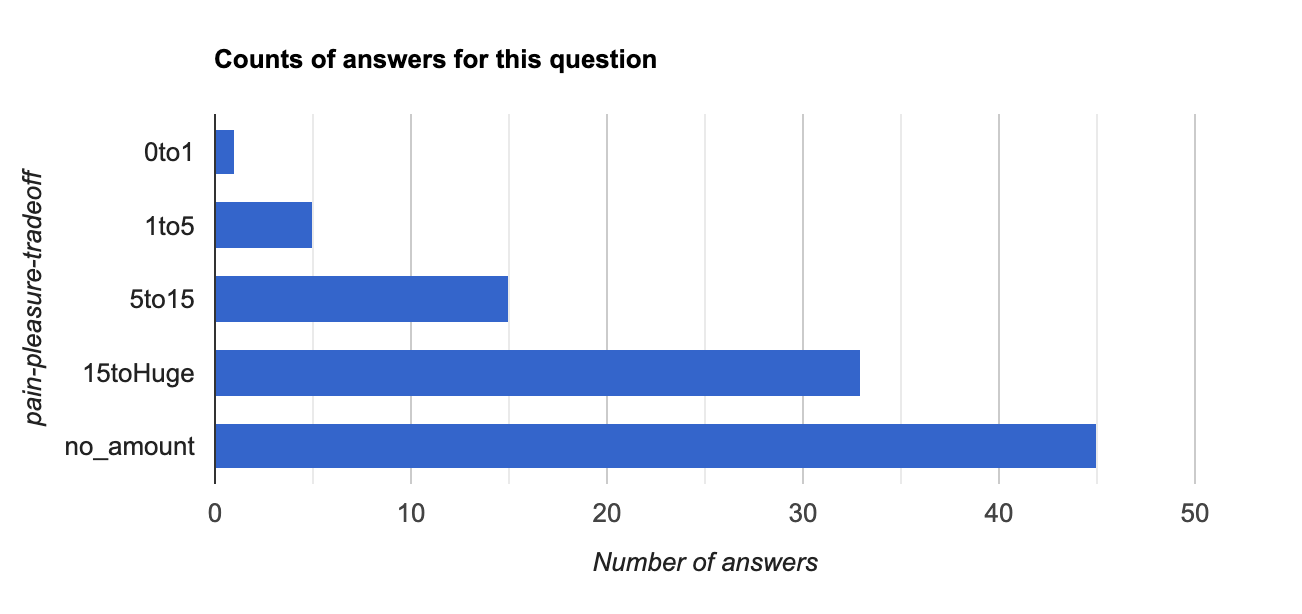
These studies suggest that suffering-focused intuitions may be more common than we might assume. In our own research at CRS, we hope to further explore whether that’s true.
Conclusion
If concern for suffering is more widespread than people realize, this could have major implications for efforts to reduce it. Making our shared concern for suffering common knowledge could enable us to more effectively reduce suffering.
Without such common knowledge, we might frame our efforts to address problems that cause suffering around other values and ends rather than suffering reduction itself. As a result, we may end up coordinating around projects that are less effective at reducing suffering—or that may even increase it.
Many people might support efforts to reduce wild animal suffering, for instance, yet if this concern is not common knowledge, we might coordinate around other, seemingly more agreeable goals, such as “protecting” wild animals in a purely conservationist sense. Protecting wild animals in this sense and reducing their suffering are distinct goals: some conservation efforts, such as rewilding, could plausibly increase wild animal suffering. Similar dynamics might apply to other issues that might involve significant suffering, such as artificial sentience and space colonization.
Of course, people may not be particularly suffering-focused. But plausibly, many have at least some concern for others’ suffering and believe that reducing it should be a priority, even if not a foremost one. If common knowledge is as powerful a difference-maker as Pinker and others suggest, making our shared concern for suffering common knowledge could be very valuable.